

Positive Education Always Corrects Error: Interview with Jideofor Muotune (theAfrowegian)
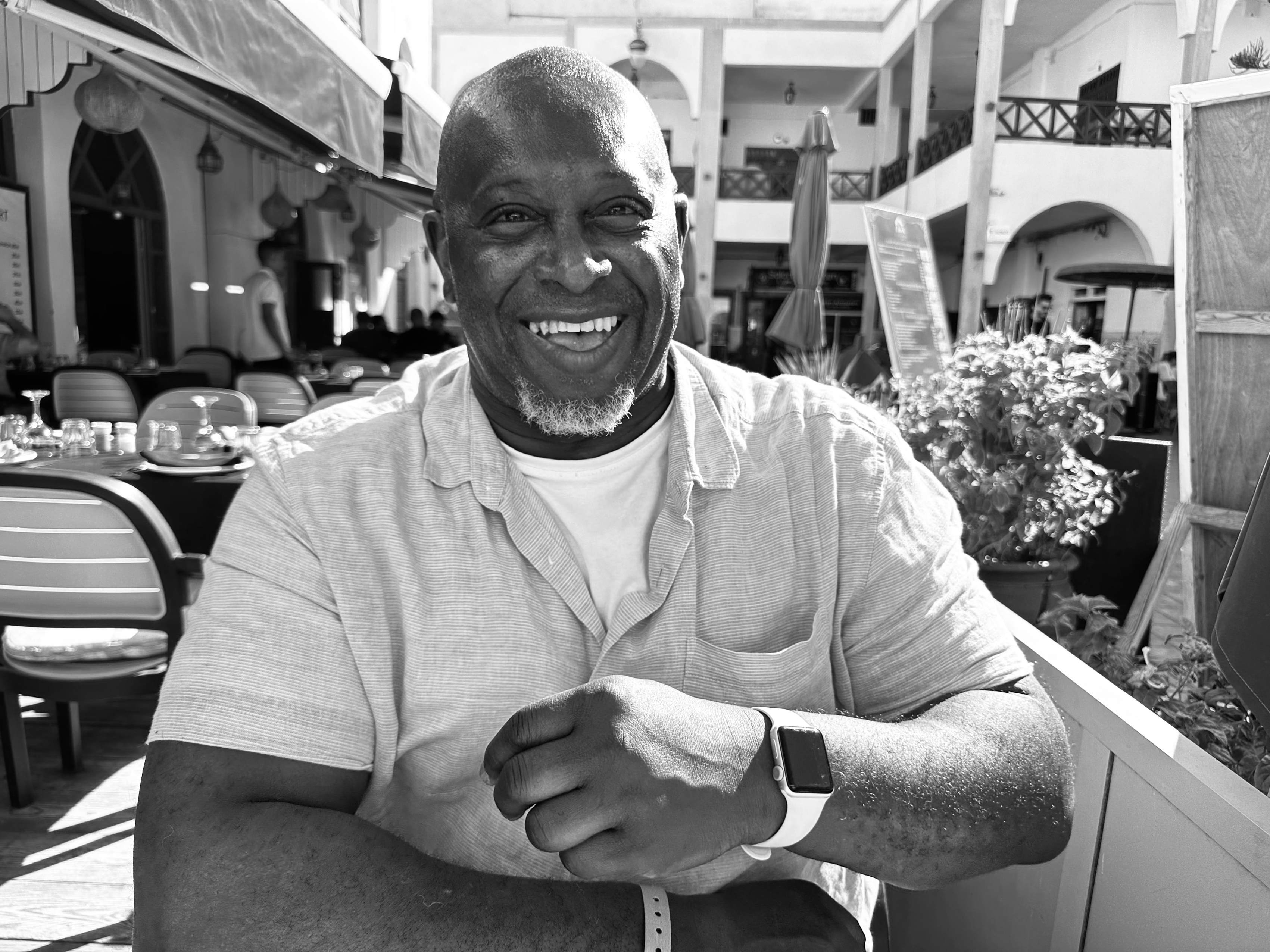
Jideofor Muotune is a multi-disciplinary artist and founder of theAfrowegian, a platform dedicated to fostering nuanced debate about race and culture in Scotland.
From his early days as one of the founding members of Glasgow’s Soma Records to his current work as theAfrowegian, Jideofor has always been interested in audio as a tool to bring people together and reshape access.
Through the telling of Black histories, his work often aims to shift perspectives around race and colonisation. Jideofor’s work moves across theatre, music, public history, immersive audio and community storytelling. Much of it asks difficult but necessary questions about Scotland’s relationship with the transatlantic slave trade.
We spoke to Jideofor about Black perspectives in Scottish heritage and his upcoming walking tour, The Listener, which explores Glasgow’s Merchant City through the stories of the Tobacco Lords.
Book tickets for any of the eight walking tours during 25-31 July 2026 by clicking the button below. Tickets are free of charge.
Edward Strutt, Scottish Civic Trust [referred to hereafter as ES]: Thanks for joining me today, Jideofor. I wanted to ask what is your connection to Scottish civic life and how has that informed your work as theAfrowegian?
Jideofor Muotune (theAfrowegian) [referred to hereafter as JM]: So it's funny, because my first thought when you asked me that is what really is Scottish civic life? what does that really mean? And civic life for me is, I suppose, public life. Within my story, my background is publicly really about a record label I set up with some friends years ago called Soma Records, an electronic dance music label, which came out of this idea of the Sound of Young Glasgow.
My pals and I were listening to music coming from Chicago and Detroit, getting inspired by it, realising there wasn't the infrastructure in Glasgow to release and record this music. So in a punk DIY ethic, we said, right, let's do it ourselves and we started Soma records.
Over time it grew and it's still going 35 years on. It has been recognized as part of Glasgow's cultural heritage, the record label. I suppose that's the start of my engagement with Scottish civic life.
The proudest moment for me was releasing the song ‘Positive Education’ on the label Soma Records and partly because of the lyric that is in the track, and later within my podcast as theAfrowegian; “positive education always corrects error”. This is something I live by.
The label really was at the forefront of electronic music and culture. We put out the French duo Daft Punk’s first single in 1994; they had heard Positive Education and loved it, recognising this record as drawing a line in the sand between underground and overground.
These experiences shaped my understanding of audio, not just simply as a tool, but as a cultural force capable of reshaping access, distribution and authorship. This was such a formative moment in electronic dance music which saw a global expansion in the 1990s. This shaped my awareness of how sound, innovation and community can intersect.
That laid the basis for interactions in Scottish Civic life which led to me presenting and co-producing a BBC radio documentary Trading Truth (2007) about Glasgow's links to the slave trades, which was at that time, the two hundredth anniversary of the law abolishing the slave trade.
I know that this was something that inspired other people involved in civic life to increase their focus on built heritage, like Stephen Mullen, a friend and author of the book It Wasnae Us: The Truth About Glasgow and Slavery.
Around that time, The Glasgow Anti-Racist Alliance (GARA) (later renamed Coalition for Racial Equality and Rights (CRER) in 2006) were the predominant anti-racist organisation, and they were running walking tours of Glasgow's Merchant City.
I was blown away to see queues around the streets, this experience certainly catalyzed the idea at the time of walking tours as a way to bring people on board with historical storytelling.
How I engaged with this was a result of hearing and seeing some history I felt a personal connection to. I was looking at an interview I did nearly 30 years ago for a fashion article, where I was visited in my recording studio by The Herald. This was where I first mentioned the name ‘theAfrowegian’ in print. This moniker made a lot of sense to me, being very proud of my birthplace, Lagos, Nigeria and my experiences being brought up in Glasgow that created this dual heritage.
Another turning point for me jumps forward many years to around the time just after the brutal murder of George Floyd in Minneapolis in 2020. I was pulling together an event at the Royal Conservatoire of Scotland focussing on the past, present and future of black music in Scotland.
A young black promoter that was on the panel had said that she wasn't aware that I was involved in the founding of Soma Records. This really made me question my visibility within civic life, especially because she had said that she hadn't seen any Black music professionals whilst growing up in Scotland. This highlighted the idea of “you can't be it, if you can't see it”.
This was a real shocker to me and it was at this point that I decided to set up theAfrowegian project and revisit something which ties together and centres my wider practice as artist and storyteller.
ES: For readers who are new to your work, how would you describe theAfrowegian project and what you set out to do through it?
JM: theAfrowegian for me is my journey towards storytelling in a way that makes sense to me. I love stories. I was brought up with stories with my mother and father about Nigeria. This oral history is very characteristic of West Africa and that's where my love of passing on stories comes from.
With my background in electronic dance music and technology, I see audio as an underutilised medium for storytelling. This idea that you can use immersive audio to take people back in time is a part of what I try to do with The Listener and other projects.
theAfrowegian is about storytelling lead from a black gaze. It's important that it's led from a black gaze because a lot of the stories that we hear in Scotland aren't and what I mean by that is considering perspectives of people like myself, considering what feels right to us and leading with that.
theAfrowegian is always coming from an attempt to be inclusive, accessible and aiming to take people with us especially when you're looking at history. It's not just black Scottish people's history, it's all of our history.
If we consider the history of Tobacco Lord’s, something that I’m very interested in. The major book The Tobacco Lords: A Study of the Tobacco Merchants of Glasgow and Their Trading Activities, c.1740-90 that was published in 1975 by Tom Devine, mentions slavery on just two of its 200 pages. That's what I mean about re-establishing the history of the black experience within this period.
If a black person had written that, it wouldn't be two pages, this is what I'm trying to turn around. But as I say, still taking people with us in a way that doesn't feel like people are excluded. Whilst it is tricky, my thing is all about trying to present information. I'm not presenting my point of view with things. I'm presenting information and letting the Scottish civic audiences decide what they do with that information.
ES: That’s a fascinating journey, this transition drawing from your time as a musician responding to the black musical forms of Detroit techno, then leading into projects that open up wider conversations and experiences of black history through listening.
JM: Well, it's funny, I wanted to add, as you were talking about the kind of journey I've been on with this trendy techno with Positive Education. Along that journey, I also produced music for [children's TV show] Balamory.
I wrote musical themes for the diverse characters in the show. It was incredible to write the character songs for the Black characters Josie Jump and Spencer the Painter as well as Penny Pocket who was a wheelchair user.
When producing Josie Jump’s theme, I had used Samba drums; her quirky dancing and character seemed to fit with the Latin rhythms. I then wrote the second character song for Spencer the Painter and I'd recently got back from Cuba and felt inspired and so that came through in the character song.
I still laugh thinking about this, because the girl in the wheelchair, Penny Pocket, has a kind of Geordie accent and her character song has a rap in it. I still remember sitting in a café in Edinburgh with the director singing and rapping to him in a Geordie accent.
Both things I'm very, very proud of, because they are still relevant within Scottish civil society. Balamory is a big programme and you had this situation where you had Black characters in this fictional village. It’s that thing again about diversity and representation; you can't be it if you can't see it.
The arts is a great way to do that, and I look at my practice as storytelling as multi-platform storytelling. I'm interested in all the different ways that I could tell the story, but it's the story that's the most important thing.
ES: How do you consider different methods of listening through your projects with the variety of technologies available today?
JM: In my recent projects, I’ve been playing with AI-powered programmes. There's a lot of discussion around AI and especially the environmental effects of it. I'm aware of that and I look at it in terms of almost like the return on the investment. If you can for a thousand pounds create an AI-powered experience for people, which would be inclusive and accessible in a way that other anti-racist educational initiatives aren't that you'd create for a thousand pounds including PowerPoint presentations and printed materials. Then that's where I justify the negative environmental effects to myself.
I came across the story of a cyclist called Major Marshall Taylor. He was the first Black American sporting superstar. When I came across his story, it blew me away because it was 34 years after the end of slavery in the United States, this is the Jim Crow era where people are being lynched by mobs and this guy fought against racism to become cycling champion of the world.
He wrote a book about his experiences, and this is what I input into an AI programme, the book being out of copyright represented an opportunity to tell his story in a low-cost and interactive way. Through AI tools and my own research, I created a voice for Major Taylor informed by the contents of his book, people could literally speak directly with Major Taylor individually and ask him questions about how he felt about the racism he experienced as well as the allyship he experienced which helped him become successful.
ES: That’s an interesting usage of AI, particularly against a backdrop of Large Language Models being used across social media to drive division and misinformation. To hear of a project which seeks to empower individuals with historic accounts is powerful. Tell me more about The Listener project and the walking tours in Glasgow’s Merchant City.
JM: Within this project I'm using immersive audio to engage audiences and hearing from black people about their experiences in engaging with built heritage.
I'm talking to various academics, activists, lots of people from my networks about how they feel about certain buildings in the Merchant City such as The Tobacco Merchants House, Hutcheson's Hall and Trades Hall. I'm speaking to them, presenting them with information that I've curated about the histories of these buildings and getting their opinions on them.
When we move forward with the next iterations of these tours, I think what's important to me is that audiences will be able to hear black and brown voices on the history of these buildings, their opinions, which are interesting and inspiring.
One of the contributors is an asylum-seeking woman who had felt guilty about being some kind of drain on society. But when she understood that her ancestors, through slavery, had contributed to the building of Glasgow. The incredible growth that happened in Glasgow between 1707 and 1807 was a direct result of the Act of Union opening colonial trade with the Americas, which allowed the city to dominate the global tobacco and sugar trades through the exploitation of enslaved labour. She then no longer felt guilty, she felt that her ancestors are a part of it. For me, that change represents empowerment and that’s what this project is all about.
ES: In your experience, what do you think is still overlooked in the way that Scotland talks about the histories of the Transatlantic Slave Trade?
JM: I think that my pal Stephen [Mullen] summed it up in that book, It Wasnae Us, because there wasn't so much direct slave trading happening in the same way as happened in Bristol and London, Liverpool, or so the Scots think or tell themselves stories that it wasn't us, we weren't involved in it.
And partly that subtext, of, It Wasnae Us, it was the English, I think that that's part of history which is tricky and I think is often overlooked.
I think [wider understanding] is becoming a wee bit more prevalent, but certainly not enough. I’ve been inspired by the fact that organizations like the Coalition for Race Equality and Rights who ran the walking tours, were organized at that time by a white guy called Frank Boyd. This is another example of someone who has taken everybody on the journey together, it's incredible that this fella was doing that over 25 years ago.
Within the Scottish Government's race equality framework there are provisions that relate to storytelling, community-based storytelling, linking it to the legacy of the slave trade and colonialism.
The government want to support that storytelling and importantly, that it has a lot of impact on the problems that we see with ethnic communities today. I do think that there is the infrastructure for it, but I don't think it's being done anywhere near big enough.
I think it's about doing what happened to me, finding the histories that speaks to you, this creates what I would call citizen historians.
I do think there's certain types of people that are often the one telling these stories and these histories are the ones who have the time and energy and they've often come from wealth and are able to do it. That's one of the things that I love about Stephen [Mullen]. He is a white working class fella from Wishaw who is telling the stories of Scotland’s involvement with the Transatlantic Slave Trade.
Often, I think of proverbs as a great way of sharing learning across cultures and across generations.
My favorite proverb is from the father of African literature, Chinua Achebe. And he says, "Until the lions have their own historians, the history of the hunt will always glorify the hunter"
That quote really speaks to me and reminds me why it is so important that we all try to tell our own history. One of the things I would really point to when I start conversations with people about the legacy of the Transatlantic Slave Trade, people often say, well, we had indentured servitude. The most important thing to understand about the legacy of Transatlantic Slave Trade is it relates to black, brown people, Africans, or even from the black gaze is this difference between chattel slavery and indentured servitude and chattel slavery meaning very simply that the “master”, owned you as the enslaved person, your output, your children, your wife, everything.
Indentured servitude is something that might have happened for five years. You worked your way through it and then you were free. Chattel slavery was generational and gone for hundreds of years.
In a podcast that I made about Glasgow's relation to the slave trade called Trading Truth, recently departed Professor Sir Geoff Palmer, God bless his soul, talked about Chattel slavery being “the most profitable evil the world has ever known”. His words not mine, but I think that sums it up and it's starting from that difference which again is this idea of the black gaze.
ES: That was fascinating, thank you for sharing. Thinking about inclusion and what this looks like in heritage work; what can heritage organisations do better, beyond surface level representation?
JM: Where I feel the truth here is all about power. It's about getting the power over to the communities, the hard-to-reach communities that we are trying to engage and that's difficult for people to do.
It's always difficult for people to give away power properly. There's a financial aspect to it as well, I also think that you have to be able to make mistakes. Long term change at a strategic level to be lasting is likely to develop at a slow pace. But it comes down to giving the people that you want to tell the stories the power to tell those stories.
We have a certain amount of power to be able to do that and a lot of my work is trying to empower people to feel confident about telling their own stories and I'm still learning all the time, how best to do that.
There's a lot of nuanced storytelling going on across social media. And although audio is my main form, if you make a podcast, you also need to have it visualised to promote it, It's interesting how things are changing.
I think that some civic organizations are trying to do good work and heading in the right direction, however I truly feel there needs to be much much more work being done in this area.
What seemed to happen after the brutal murder of George Floyd is that things opened up; people started to really embrace and create spaces for diverse voices to tell their stories, to engage in heritage. It feels like it's not as important to some organizations in the same way; it's like they've ticked the box and I think it's important that these organizations are held to account.
There are people within my network that are doing great work in doing that and looking at the stats and the figures and saying, well, you said for your multi-year funding, you would do this and you're not doing this and this is authentic. And again, it's very tricky because people get annoyed when things have opened up.
And you know, and there's that whole difficulty about coming across as the angry black person or whatever else. I try to be strategic and keep my eye on the prize. Professor Sir Geoff Palmer was a very big influence on me and he managed to maintain his grace. And as I say, it really comes back to, it comes back to handing over power, which is a difficult thing.
When I have advised boards on equality and diversity, the ones that have been the most successful have been the ones where we've given power to the communities and the audiences we're trying to interact with.
There's one particular program called Power Up, which is administered by the PRS Society, Performing Rights Society. That's incredible because it does offer funding to an intake of 20 black music creators and 20 black music industry professionals and it's now been funded over 10 years. The idea is that over the period of the project, 400 people will be funded to create a network where everyone will support each other.
I used to try and work towards one and one making three and now it's about working towards one and one making eleven -- creating something that's bigger than yourself, that was the whole thing with Soma Records, the whole thing with theAfrowegian and there are other Afrowegians, it's bringing other people together so that you have that compound effect and maybe make positive changes as result.
ES: I think that brings me on to the last question. Thanks for meeting with me today, it’s been great to speak with you. What events do you have coming up and how can people get involved?
JM: The Listener is an immersive walking tour which takes in six buildings in a short walkable route through the Merchant City, these walks will take place on 25-31 July during the period of the Commonwealth Games. [Click here to book]
During October, Black History Month, I'll be supported by other Afrowegians running walking tours which people can get involved in. I also plan to host a few conversations about the Commonwealth games – even that phrase freaks with my head. What is Scotland in the Commonwealth in 2026?
Another project focusing on the history of Major Taylor, the Black American sporting superstar, I'm planning will be a sound system cycling event that will happen in October. A few years ago, in telling the story, I created a lot of music around Major Taylor. We did some performances in George Square and I’m rebuilding that this year. theAfrowegian sound system, where I’ll showcase and highlight some artists that have blown me away.
My primary practice now isn't making music, it's using and exploring multi-platform storytelling. But I've been so blown away by some young black artists that I've seen and it's inspired me to write some stuff. One of the artist featuring in the Major Taylor project is spoken word artist, Courtney Stoddart from Edinburgh, who’s incredible as well as a musician called Mark Agbe, who wrote a song called Glory. I also made some techno as well with a couple of people from the old Soma days. I'll be presenting all of that as a sound system that will be on bikes.
And as part of The Listener, I'll also be doing an exhibition where I'll present portraits of everyone who has contributed to the Listener and they involve some augmented reality; storytelling with pictures and audio and I’ll be presenting some of my research materials that I curated for the project.
What’s been empowering for me and for the contributors I've been talking to, as black people talking about our feelings around what's happening in Scottish society today; especially around the rise of the far right and hearing about protests amid racial tensions rising.
What inspires me to go forward with my storytelling is including the facts when responding to harmful far right rhetoric. For example, when these individuals direct the question of, “why have you come here?” or whatever - people are lost on the fact that, colonisation meant that this was the mother country for those who migrated.
People came to the UK as a result of this, in some cases people were invited to come over and it’s these basic truths have been lost and so, as I say, “positive education corrects error”.
To find out more information about Jideofor's work as part of the multi-arts platform, theAfrowegian, visit theafrowegian.org/
Follow theAfrowegian on Instagram: @theafrowegianscotland / Facebook: theAfrowegian