


Glasgow Subway Heritage Crawl: Exploring the City’s Architectural Story Underground
Discover Glasgow Beyond the Underground
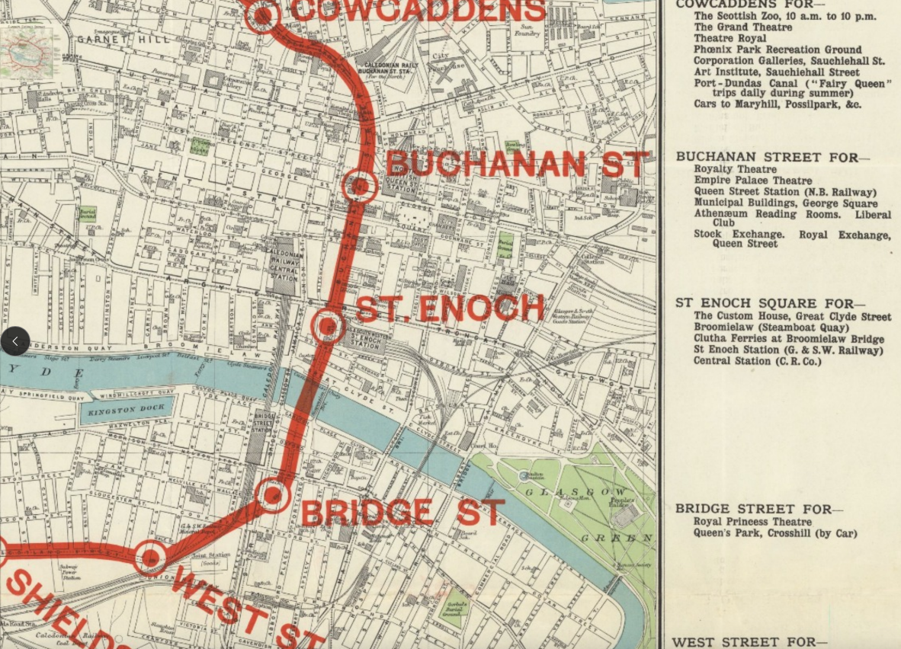
Glasgow’s Subway is often seen as a simple circular transport system, but it can also be read as a map to the city’s past. Curated through the Scottish Civic Trust Archives, this “Sub Heritage Crawl” offers a unique way to experience Glasgow: eight walking routes, eight stations, and countless stories embedded in stone, iron, and imagination.
How the Trail Works
Glasgow’s Subway forms a continuous circular route, making it ideal for exploration. The heritage trail builds on this structure by dividing the city into themed walks from key stations.
Each route highlights distinct architectural periods and styles, key historic buildings and civic landmarks, and Glasgow’s transformation from industrial powerhouse to cultural city.
St Enoch: Cast Iron and Industrial Elegance
The St. Enoch area highlights Glasgow’s pioneering use of cast iron in architecture. Once a cheaper substitute for stone, iron became a medium for creativity and innovation.
Gardners Warehouse (1855) on Jamaica Street, designed by John Baird, demonstrates how industrial materials could achieve refinement. Its balanced proportions, iron structured frame, and surviving cast lettering reflect the confidence of Victorian engineering.
Nearby, the Ca d’Oro (1872) by John Honeyman blends venetian-inspired iron tracery with a bold stone arcade, illustrating the decorative possibilities of industrial design.
Buchanan Street: The Victorian Commercial Heart
Buchanan Street showcases Glasgow at its most confident and prosperous. Between 1960 and 1910, the city developed an extraordinary collection of banks, offices, and warehouses that reflect its status as a global trading centre.
Highlights include St George’s Tron Church (1807) by William Stark, Glasgow Stock Exchange (1875) by John Burnet, a rare example of secular Gothic Revival, and the modern yet sympathetic Clydesdale Bank HQ (1980).
Continuing toward George Square, the grand City Chambers (1883) stands as one of Glasgow’s most opulent civic buildings, featuring marble interiors, mosaics, and craftmanship sourced from across Europe.
Cowcaddens: Mackintosh and the Birth of Modern Design
From Cowcaddens, the trail leads to one of Glasgow’s most iconic landmarks: the Glasgow School of Art (1897-1907) by Charles Rennie Mackintosh.
Often considered Mackintosh’s masterpiece, the building blends Art Nouveau elegance with early modernist principles and Scottish influences. Its carefully composed interiors and innovative structure markets a turning point in architectural design.
Cowcaddens offers a direct connection to Mackintosh’s creative world, where experimentation and craftmanship merged into something entirely new.
Kelvinbridge: Victorian Vision and Urban Planning
The Kelvinbridge area reflects the ambition of Victorian city planners, who reshaped Glasgow through parks, roads, bridges, and residential terraces designed for both function and beauty. Along Great Western Road, architectural highlights include Landsdowne Church (1862) by John Honeyman, St Mary’s Church (1870) by Gilbert Scott and Woodlands Church (1875) by John Burnet.
Nearby, Park Circus, designed by Charles Wilson in 1855, represents one of Glasgow’s finest planned residential developments. The area flows seamlessly into Kelvingrove Park, designed by Sir Joseph Paxton, where landscape and architecture work together as a unified civic space.
Hillhead: University and Cultural Power
Hillhead leads into Glasgow’s academic core, dominated by the University of Glasgow. Its Gothic Revival buildings by Gilbert Scott and J. Oldrid Scott give the campus its dramatic character. Highlights include the university’s cloisters, towers, and iconic spire, alongside the nearby Kelvingrove Museum and Art Gallery, built for the 1901 International Exhibition. Kelvingrove remains one of Britain’s most significant civic museums, both architecturally and culturally.
Nearby Wellington Church (1883) provides a classical contrast to the Gothic forms across the road.
Govan: Shipbuilding and Social Identity
Once a small village, Govan expanded rapidly in the 19th century due to shipbuilding along the River Clyde. Its architecture reflects both industrial strength and community life.
Key sites include The Pearce Institute (1903) by Sir Rowand Anderson, built for public welfare and the historic Old Parish Church, rebuilt in 1884 on an ancient sacred site. Govan’s built environment tells the story of industrial growth and social reform intertwined.
Cessnock and Shields Road: Classical Boldness to Modern Thought
Alexander Thomson’s Walmer Crescent (1857) near Cessnock Station is one of Glasgow’s most striking buildings. Its strict geometry, classical inspiration, and experimental form create a uniquely powerful architectural statement.
At Shields Road, the Scotland Street School (1904) by Mackintosh shows his later shift toward modernism. With its innovative lighting and simplified forms, it reflects a move away from ornament toward functional clarity.
References:
Glasgow Subway Heritage Trail,1984, Brian Edwards, Scottish Georgian Society
as researched and written by Michelle Edgar